 How-to
How Long to Break Even on a Granny Flat: 2026 Guide
Table of Contents
- The Financial Reality: What Break-Even Really Means for a Granny Flat
- Granny Flat Construction Costs and Your Capital Outlay
- Granny Flat Rental Yield: Income Potential and Cash Flow
- A Secondary Dwelling Investment Strategy for Mum and Dad Investors
- Tax, Depreciation and Negative Gearing: What Changes Your Break-Even
- Interest Rate Sensitivity and Stress-Testing Your Break-Even
- Planning, Council Approval and the Small Second Dwelling Rules
- Frequently Asked Questions
Last Updated: September 30, 2026
The Financial Reality: What Break-Even Really Means for a Granny Flat
Working out how long it takes a granny flat break even decides whether the project is worth doing. Most owners start with the build price and stop there, the wrong starting point.
Break-even is not the day the build is paid off. It is the day your cumulative net income, after every cost you actually carry, overtakes the capital you put in. That distinction matters more than any headline yield figure.
At Granny X, we work through this with Victorian owners every week. Break-even sits somewhere between a few years and well over a decade, and the gap comes down to four variables: what you build, what it rents for, what it costs to hold, and what the tax office gives back.
Gross Yield vs. Net Return: The Numbers That Matter
Gross yield is annual rent divided by total project cost; net return is what is left after every expense. Owners quote the first and live with the second.
The gap is wide. Subtract property management fees, landlord insurance, maintenance, vacancy allowance, council rates, and any utilities you carry, on a typical secondary dwelling these consume a meaningful share of rent before tax.
Model net return from day one. A build that looks marginal on gross yield can look considerably better once depreciation and negative gearing are factored in, and the reverse is also true.
Granny Flat Construction Costs and Your Capital Outlay
Your capital outlay is rarely just the contract price. Site preparation, slab pouring, service connections, fencing, landscaping, and retaining all land on the same ledger, and each one moves the day your cumulative net income overtakes that total.
The line items that catch owners out most often, and how each one moves the break-even date:
- Site access and excavation on sloping or constrained blocks. On a steep block, excavation alone can add weeks and a meaningful slice of capital, pushing break-even out by months.
- Service connections for power, water, and sewer. These vary enormously by site. A block that needs a new sewer tie-in versus one that taps an existing line is a different project financially.
- Retaining walls where the block falls away at the rear. Structural retaining is slow to build and slow to certify.
- Driveway and crossover works if the dwelling needs separate access. Council crossover approvals can sit in a queue for weeks.
- Landscaping and fencing to make the dwelling separately lettable. Skipping this delays the first tenancy, which is the same as adding cost.
Because these vary so much by site, any provider quoting a firm number before inspecting your land is guessing.
Site Preparation, Slab Pouring and Build Timeline
A concrete slab and timber frame build follows a predictable sequence: site preparation and set-out, slab pouring, frame, lock-up, fit-out, then certification.
Three things drive most of the variation:
- Weather, slab pours and external works are weather-dependent.
- Trade availability, a booked-out electrician or plumber can stall the fit-out stage.
- Service connection timing, the utility and council side of the process is often outside the builder's control.
How the Capital Stack Affects Your Break-Even Date
The other half of the cost story is funding. Two owners can build identical dwellings and reach break-even years apart because of how the capital is structured.
- Cash-funded builds break even on rental income alone, so the date is driven purely by net rent.
- Part-funded builds break even on net rent minus the interest carry, which pushes the date out but preserves liquidity for the next project.
- Equity-release builds depend on the improved valuation after completion, so the break-even calculation has to account for the new loan terms.
Granny Flat Rental Yield: Income Potential and Cash Flow
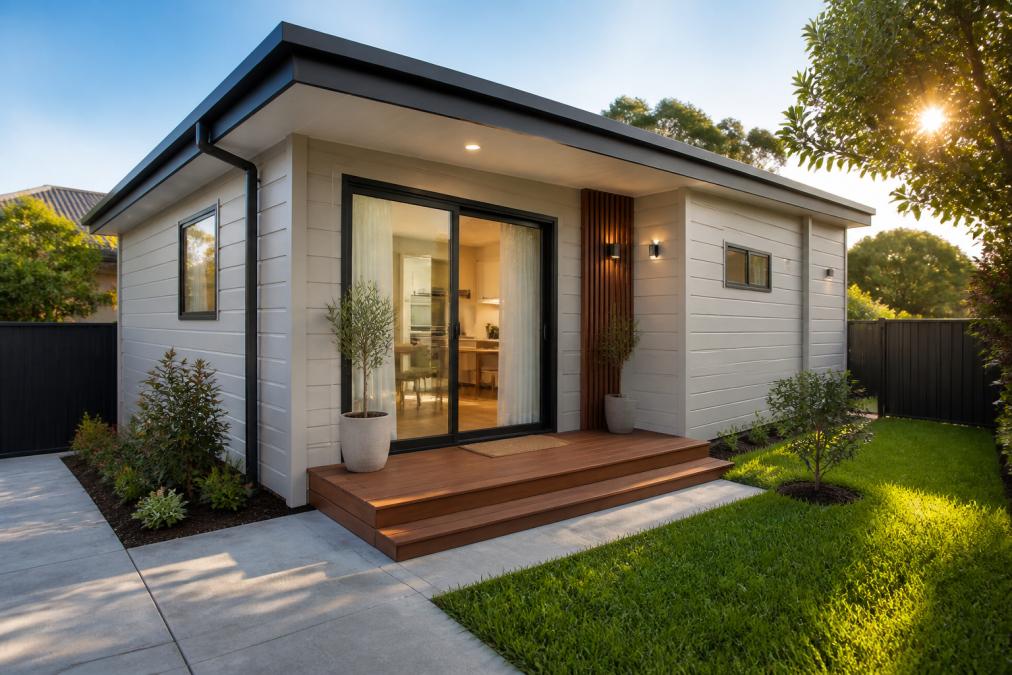
A well-built two-bedroom secondary dwelling targeting quality tenants typically returns between 10% and 15% on average, which translates to additional income of roughly $400 to $650 per week depending on location. That is the range Granny X customers see in practice.
Vacancy Rate Risk and Tenant Quality
Vacancy is the silent killer of granny flat returns: a four-week gap wipes out a month of income and adds a reletting cost on top.
A Secondary Dwelling Investment Strategy for Mum and Dad Investors
For most mum and dad investors, the strategy works best as a repeatable one: add the dwelling, let it stabilise, then use the improved cash flow and equity position to fund the next move.
Book Your Free Site Assessment →
The sequence that tends to work:
- Confirm feasibility and dwelling entitlement on your land
- Build to a standard that attracts quality tenants
- Let the income stabilise and document the improved rental yield
- Use the stronger position to support the next project
Tax, Depreciation and Negative Gearing: What Changes Your Break-Even
Tax is where the break-even maths gets interesting, and where most online calculators fall short. Almost every guide stops at gross rent, and the ones that go further still ignore two things that materially move the date: the depreciation schedule and capital gains tax on eventual sale.
Depreciation: The Deduction You Never Write a Cheque For
Depreciation on a new dwelling is a paper deduction. You do not pay it out of pocket, but it reduces your taxable income. For a newly built secondary dwelling, the two components are:
- Capital works deduction, the structural portion of the build, claimed over a long schedule set by the Australian Taxation Office.
- Plant and equipment, fixtures and fittings such as appliances, floor coverings, and hot water systems, claimed over shorter effective lives.
Negative Gearing: How the Shortfall Interacts With Your Other Income
Negative gearing works alongside depreciation. If combined holding costs exceed rental income, the shortfall may be deductible against other income, subject to your circumstances. The Australian Taxation Office sets out the rules on rental deductions and depreciation in detail, worth reading before you model anything.
Two things to get right:
- Keep every receipt for the build, the fit-out, and the ongoing costs. Deductions you cannot substantiate are deductions you cannot claim.
- Separate the loan used for the income-producing dwelling from your owner-occupier loan, so the interest is clearly traceable.
Capital Gains Tax: The Break-Even Cost Most Guides Ignore
Here is the angle almost no competing article covers: break-even is usually presented as a rental-income milestone, but the true break-even on a secondary dwelling must account for what happens when you eventually sell.
Putting the Tax-Adjusted Break-Even Together
A simple way to think about it, in mum-and-dad terms:
- Start with net rent after all holding costs.
- Add back the depreciation deduction, because it is not a cash cost.
- Subtract any tax payable on the net position, or add any refund if the property is negatively geared.
- Set aside a realistic allowance for the eventual CGT exposure.
Interest Rate Sensitivity and Stress-Testing Your Break-Even
A break-even calculation built on today's interest rate is a best-case scenario, not a plan.
Planning, Council Approval and the Small Second Dwelling Rules
Planning is often the difference between a project that proceeds and one that stalls for a year.
Frequently Asked Questions
How long until a granny flat pays for itself?
Most owners reach break-even within 8 to 12 years depending on build cost and rent. Granny X customers often find the second small home is cash flow neutral in year one, then generates positive income as rents rise. A 2-bedroom home targeting high-quality tenants returns 10-15% on average, or $400-$650 extra per week depending on location. That faster cash flow shortens the payback period compared with a standard investment property.
Does a granny flat add value to a house?
Yes, a secondary dwelling usually lifts property valuation because it adds a second income stream. Buyers and valuers assess the extra rental yield, not just the structure itself. A well-built home with a concrete slab, timber frame and 7-star NatHERS rating holds its value better than a cheaper build. Capital growth then compounds alongside the rental income, which improves your overall return on investment when you eventually sell.
What rental yield can I expect from a granny flat?
Granny X customers typically see 10-15% average returns on a second small home, equating to $400-$650 per week for a 2-bedroom dwelling built to exceed minimal rental standards. That is well above the low single-digit gross return of many standard investment properties. Net return depends on vacancy rate, property management fees, maintenance costs and landlord insurance, so factor those in before comparing against other options.
Can I claim tax deductions on a granny flat?
Yes. A rental granny flat can attract tax deductions for depreciation, interest on borrowings and eligible maintenance costs. A quantity surveyor can prepare a depreciation schedule, which often reveals thousands in deductions over the asset's life. Negative gearing may also apply if the dwelling runs at a loss. Speak with a registered tax agent about your specific situation, as eligibility depends on how the property is structured and used.
The hard part of a granny flat is not the build. It is getting the financial model right before you commit, and then getting through planning without losing a year. Granny X handles the design, permits, construction, and tenanting as one end-to-end service, with 7-star NatHERS rated builds, direct access to your builder and project lead, and a free site assessment to confirm feasibility before you spend anything. Book your free site assessment and find out what your land can earn.