 How-to
7 Steps to Fast-Track Your Council Planning Approval
Last Updated: October 26, 2026
Quick Summary
Fast-track planning approval is a simplified assessment pathway that reduces the time councils take to review and approve development applications by prioritizing eligible applications and removing unnecessary procedural steps. A standard small second dwelling application might take four to six months, while a fast-track application can land approval in eight to twelve weeks.
- Fast-track eligibility depends on development type, council area, and whether your proposal meets specific criteria.
- A complete planning permit application is the fastest route to approval; incomplete applications trigger information requests that pause the council's statutory clock.
- The statutory timeframe for most planning applications in Victoria is 60 calendar days, but the clock stops when an information request is issued.
- Lodging a complete application so the clock never stops is the fastest way to shorten processing time.
- Pre-lodgement design and preparation typically takes 4-8 weeks before council assessment begins.
Table of Contents
- What Fast-Track Planning Approval Actually Means
- Step 1: Check Your Eligibility for Fast-Track Assessment
- Step 2: Understand Small Second Dwelling Planning Permit Requirements in Victoria
- Step 3: Prepare Your Planning Permit Application Checklist
- Step 4: Lodge Your Development Application and Track Council Planning Application Status
- Step 5: Know the Planning Permit Processing Time in Victoria
- Step 6: Respond to Information Requests and Referral Agencies
- Step 7: Book Your Free Site Assessment and Get Expert Guidance
- Frequently Asked Questions
What Fast-Track Planning Approval Actually Means
Fast-track planning approval is a simplified assessment pathway that reduces the time councils take to review and approve development applications, compressing timelines by prioritizing eligible applications and removing unnecessary procedural steps.
Standard applications sit in queues, undergo multiple referrals, and require extensive information requests; fast-track applications skip redundant steps and are processed with dedicated resources.
But fast-track doesn't mean automatic approval. It means faster assessment against the same planning rules, the speed comes from efficient processing, not lowered standards.
Step 1: Check Your Eligibility for Fast-Track Assessment
Not every development application qualifies for fast-track assessment. Eligibility depends on the development type, the council area, and whether your proposal meets specific criteria.
Most fast-track pathways in Victoria apply to:
- Small second dwellings (granny flats) under certain size and design parameters
- Residential developments in designated growth areas or master-planned communities
- Housing proposals that meet state significant development thresholds
The first step is understanding your council's specific fast-track criteria.
Your eligibility hinges on:
- Property location, Is your land in a council area with fast-track pathways?
- Development type, Does your proposal fit the eligible categories?
- Design compliance, Does your design meet the planning standards upfront?
If you're unsure whether your project qualifies, contact your council's planning department directly. Alternatively, understand the latest planning changes and eligibility criteria for fast-track approval in Victoria.
Step 2: Understand Small Second Dwelling Planning Permit Requirements in Victoria
Small second dwellings, commonly called granny flats, have their own planning rules in Victoria. Understand them before you design or lodge an application.
Recent Victorian reforms have expanded what's permitted and simplified approval pathways for properties that meet specific criteria. The rules now allow:
- Dwellings up to 80 square metres (gross floor area) in most areas
- Flexible siting options on residential land
- Simplified assessment for applications that comply with design standards
Key planning requirements typically include:
- Setbacks from property boundaries (usually 1-2 metres minimum)
- Site coverage limits (the percentage of land you can build on)
- Height restrictions (often 7-8 metres for single-storey designs)
The exact rules depend on your council's planning scheme and whether your property sits in a designated area.
Watch out: assuming your council's rules match another's is a common mistake. What's permitted in one area might trigger a planning permit requirement in another, even if councils are nearby.
Step 3: Prepare Your Planning Permit Application Checklist
A complete planning permit application is the fastest route to approval.
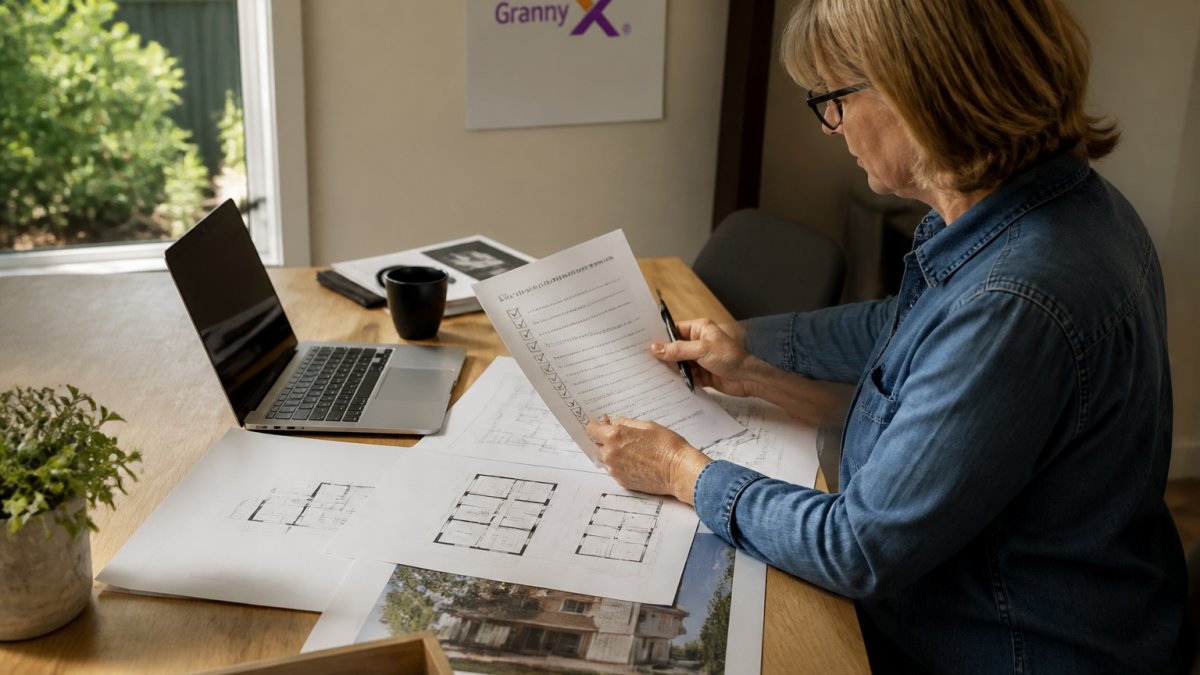
The council's assessment clock stops when it issues an information request and restarts only when you provide the missing information.
A typical planning permit application for a small second dwelling includes:
- Application form, Completed council form with property details and applicant information
- Site plan, Scaled drawing showing the property boundary, existing buildings, and the proposed dwelling location
- Floor plans and elevations, Detailed drawings of the new dwelling showing all dimensions and design details
Get the complete end-to-end process context before diving into the fast-track steps.
Before you lodge, verify your council's specific checklist. Some require additional documents or accept simplified versions for certain application types.
Step 4: Lodge Your Development Application and Track Council Planning Application Status
Lodging your development application officially starts the council's statutory assessment clock. From this point, councils have a set timeframe to issue a decision.
When you lodge, the council will:
- Check that your application is complete
- Issue a formal receipt and reference number
- Begin the assessment process
- Notify relevant referral agencies (if required)
- Issue a decision notice once assessment is complete
Your role during assessment is to monitor progress and respond promptly to information requests. The faster you respond, the faster the council can complete its assessment.
Most councils offer online tracking systems where you can check your application status using your reference number to see:
- Current assessment stage
- Any information requests issued
- Referral agency feedback
Tracking regularly helps you spot delays early. If the council hasn't contacted you within 2-3 weeks of lodgement, follow up to confirm they have everything they need.
Step 5: Know the Planning Permit Processing Time in Victoria
Processing time is where most fast-track claims fall apart, because the number a council quotes and the number you experience are rarely the same. Understanding the statutory clock, and what pauses it, is the most useful thing you can learn before you lodge.
The statutory clock, explained
In Victoria, a planning permit application is governed by a statutory timeframe under the Planning and Environment Act 1987. For most standard applications, the council has 60 calendar days from the day after it receives a complete application to decide. That clock is not a guarantee of a decision date; it is the point at which you gain certain rights if the council has not acted.
Book Your Free Site Assessment →
Three things matter about that clock:
- It only starts on a complete application. If the council considers your application incomplete, it can request further information under section 54 of the Act, and the clock does not run while that request is outstanding.
- It stops when an information request is issued. The clock restarts only when you have supplied the requested information (or the council waives the requirement). This is the single biggest source of timeline blowouts, and it is entirely within your control if you lodge a complete package.
- It can be extended by agreement. Councils will often ask you to agree to an extension of time, particularly where referrals or objections arise. You are not obliged to agree, but refusing can push the matter toward a deemed refusal and review at the Victorian Civil and Administrative Tribunal (VCAT).
What the clock does not cover
A common misconception is that the 60-day clock is the whole story. It measures the council's decision-making period, not total elapsed time from first phone call to permit in hand. Realistic end-to-end timelines for a small second dwelling usually look like this:
- Pre-lodgement and design: 4-8 weeks, depending on whether you need a survey, arborist report, or geotechnical advice.
- Council assessment (complete application, no referrals, no objections): commonly 8-12 weeks on a fast-track pathway, 12-16 weeks on the standard pathway.
- Council assessment with one information request: add 3-6 weeks, sometimes more if the request triggers redesign.
How to verify current timeframes
Before you lodge:
- Check the council's planning scheme and its published application-processing policy. Many councils publish a service standard or customer-service commitment that states target decision times.
- Ask the duty planner directly what the current median is for your application type, and whether the council has a fast-track queue with dedicated staff.
- Check the council's planning register (often searchable online) for recent decisions on similar proposals. The lodgement and decision dates are usually visible, which gives you a real-world sample rather than a marketing figure.
What actually extends the clock
The factors that most often blow out timelines are predictable:
- Incomplete lodgement, the clock never starts, or stops almost immediately.
- Referral requirements, some applications must be referred to external agencies, and their response times are outside the council's control.
- Objections, a single objection can convert a straightforward assessment into a negotiated outcome or a VCAT proceeding.
The fastest way to shorten processing time is not to chase the council, it is to lodge an application so complete that the clock never stops. Every information request you avoid is worth roughly three to six weeks.
For a realistic timeline for your property, have a planner review your draft application against the council's checklist before lodgement, not after.
Understanding realistic timelines for each phase of the approval process helps you plan effectively and avoid common delays.
| Phase | Typical Duration | Key Factor |
|---|---|---|
| Pre-lodgement and design | 4-8 weeks | Survey, reports, design work |
| Council assessment (complete, no referrals) | 8-12 weeks fast-track | Statutory clock runs uninterrupted |
| Council assessment (standard pathway) | 12-16 weeks | Standard processing without fast-track |
| Assessment with one information request | Add 3-6 weeks | Clock stops until response received |
| Assessment with referral or objection | Add 4-12 weeks | External agency response times |
| Statutory decision timeframe | 60 calendar days | Runs only on complete applications |
Step 6: Respond to Information Requests and Referral Agencies
Once your application is lodged, the assessment stage is where fast-track applications are won or lost. Most of the delay in this phase comes from two sources: information requests (often called RFIs) and referrals. Handling both well is a skill, and it is the part of the process most applicants underestimate.
Information requests: what they are and why they matter
An information request is the council's formal request under section 54 of the Planning and Environment Act 1987 for further information before it can assess your application. It is not a rejection. It is a pause button, and a costly one, because the statutory clock stops until you respond.
Requests typically fall into four categories:
- Design clarification, the council wants amended plans showing how a setback, site coverage, or height standard is met.
- Technical reports, missing stormwater, geotechnical, arborist, or energy reports.
- Written justification, a planning report explaining why a variation to a control is acceptable.
How to respond well
- Read the request against the Act and the planning scheme. If a requested item is not actually required, you can (politely) say so and ask the council to proceed. Councils sometimes request documents out of habit.
- Respond in full, not in part. A partial response usually triggers a second request, which restarts the delay.
- Respond before the deadline. The council will specify a timeframe, commonly 14 days but sometimes longer. Missing it can lead to the application being deemed withdrawn or refused.
- Keep a dated record of what you sent and when, and confirm receipt in writing.
Referrals: who gets consulted and why it matters
Some applications must be referred to external agencies under the planning scheme or the Act. For a small second dwelling, the most common referrals are:
- The relevant water authority, for stormwater discharge and connection, and sometimes for easement impacts.
- The local council's own engineering or drainage unit, often an internal referral rather than an external one.
- Transport for Victoria or the local roads authority, where the proposal affects access, parking, or traffic on an arterial road.
Referral authorities have their own response times, and the council cannot always control them. If a referral authority objects, the council generally cannot grant a permit contrary to that objection without a specific power to do so, which means resolving referral concerns early is essential.
Objections and what to do about them
If a neighbour or another party objects, the council must consider the objection. In practice, most objections are resolved through amended plans, a planning meeting, or a negotiated outcome. If they are not, the council may issue a Notice of Decision to Grant a Permit with conditions, which the objector can appeal to VCAT. Alternatively, if the council refuses, you can appeal to VCAT yourself.
The cost context competitors leave out
Assessment-stage costs are rarely discussed, but they matter to the cost-benefit of professional help:
- Council planning permit fees for a small second dwelling are set by the Planning and Environment (Fees) Regulations and are typically in the hundreds of dollars, not thousands, for a single dwelling.
- Referral authority fees may apply separately and are usually modest.
- A town planner to manage an RFI response commonly costs a few hundred to a low four-figure sum per response, depending on complexity.
Against that, the cost of a single avoidable information request, in time, redesign, and lost rent or construction delay, usually exceeds the cost of having a planner review the application before lodgement.
A practical assessment-stage checklist
- Confirm in writing that your application is complete and the clock has started.
- Diarise the statutory decision date and the response deadline for any RFI.
- Identify every referral authority and confirm whether their response has been received.
Handled this way, the assessment stage becomes a managed process rather than a waiting game, and that is the real difference between a fast-tracked approval and a slow one.
Step 7: Book Your Free Site Assessment and Get Expert Guidance
A site assessment typically covers:
- Property dimensions and orientation
- Slope and soil conditions
- Existing vegetation and tree protection
A site assessment identifies issues before you invest in detailed design or planning applications.
At Granny X, we conduct free site assessments to understand your property and confirm feasibility.
Learn site-specific considerations that affect planning approval requirements and preparation.
If you're considering a small second dwelling and want expert guidance on fast-tracking your approval, book your free site assessment.
Fast-tracking your council planning approval requires preparation, completeness, and understanding your council's specific requirements.
Frequently Asked Questions
How can I speed up a council planning application?
Submit a complete application with all required supporting documents before lodgement to avoid information requests that pause the statutory clock. Engage a town planner or planning consultant early to identify potential issues. Provide clear, accurate site plans and technical reports. Respond promptly to any council requests. For small second dwellings in Victoria, confirm whether your proposal qualifies for fast-track assessment or exemptions that bypass planning permits entirely.
Can a small second dwelling be built without a planning permit in Victoria?
Yes. Granny flats and small secondary dwellings can be built without a planning permit in Victoria if they meet specific planning rules, including size, setback, and design standards set by your local council and the planning scheme. However, you may still need a building permit and must comply with all planning controls for your property. Always confirm eligibility with your council or a planning consultant before proceeding.
How long does council planning approval take in Victoria?
The statutory timeframe is typically 60 calendar days from lodgement for a complete application. However, the clock pauses when the council issues an information request, you then have 10 business days to respond. If you miss the deadline, your application may be refused. In practice, most applications take 8-16 weeks because of information requests, referrals to other agencies, and council workload. Fast-track pathways and exempt developments can be quicker.
What documents do I need for a planning permit application in Victoria?
Essential documents include completed application forms, site plans showing property boundaries and proposed layout, architectural drawings, a planning statement explaining compliance with planning rules, and technical reports (such as traffic, environmental, or heritage assessments if required). Your local council's website lists specific requirements for your property type. A town planner can help identify which documents your proposal needs to avoid delays.