 how-to
Granny Flat Investment Return Calculator 2026
Table of Contents
- What You'll Need Before You Calculate
- Understanding Granny Flat Construction Cost Estimate 2026
- Secondary Dwelling Planning Permits Victoria: What You Need to Know
- Rental Yield Calculation for Investment Properties
- How to Use the Granny Flat Investment Return Calculator
- A Worked Example: From Upfront Cost to Annual Return
- Common Mistakes to Avoid When Calculating Granny Flat Returns
- Frequently Asked Questions
Last Updated: October 7, 2026
What You'll Need Before You Calculate
Before running numbers on a investment return calculator, know what you're calculating: a self-contained secondary dwelling on your existing property that generates rental income.
The setup matters more than the maths.
Here's what you need to gather before opening any spreadsheet:
- Your total project cost estimate (we'll cover how to calculate this)
- Your expected weekly rent based on local demand (we provide a rental appraisal inhouse)
- Your loan details (if you're financing the build)
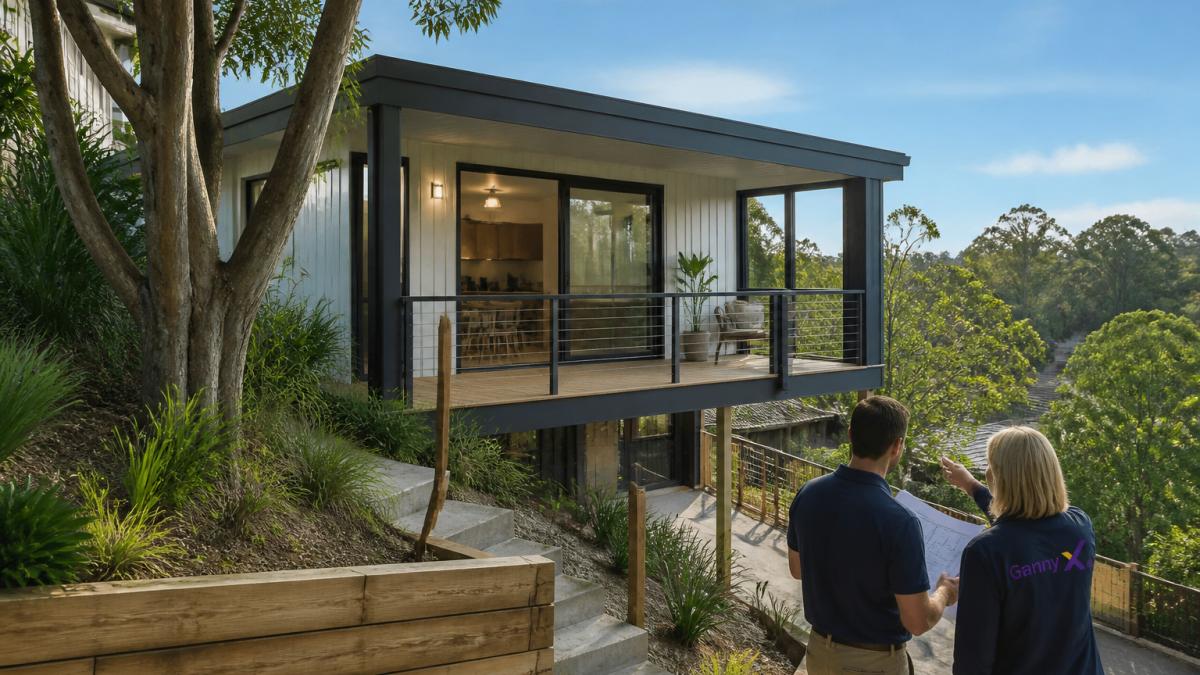
We start every project with a feasibility assessment. A steep slope, poor access, or tight zoning can change everything, so lock those variables down first.
Understanding Granny Flat Construction Cost Estimate 2026
Your total project cost is the foundation of any return calculation. It's not just the build cost. It includes site work, approvals, and often hidden expenses that surprise owners mid-project.
Build costs and site preparation
Construction depends on size, materials, and site conditions. A standard granny flat runs 40-60 square metres, typically concrete slab and timber frame.
Site preparation is the hidden cost that derails budgets.
Get a site assessment done. It's the only way to know if you're looking at a straightforward build or a complex one.
Approval and feasibility costs
Planning approval isn't always required in Victoria. Small second-dwelling rules sometimes allow building without a planning permit if your site meets specific criteria.
Feasibility studies, survey reports, and soil testing cost money upfront. Budget for them separately from construction, they're part of your total project cost.
Secondary Dwelling Planning Permits Victoria: What You Need to Know
Victoria's planning rules for secondary dwellings have changed. Understand what applies to your site before spending money on design or approvals.
Small second-dwelling rules and exemptions
Meeting these criteria skips the planning permit stage entirely, saving time and money. Otherwise you'll need formal approval, which adds cost and extends your timeline.
The exemption is valuable when it applies. Check your local council's planning scheme to see if your block qualifies.
Building permit requirements and approval timelines
Even without a planning permit, you'll need building permits for sign-off. Building approval typically takes 4-8 weeks; construction takes 12-16 weeks for a standard secondary dwelling.
Registered Building Surveyors differ. Those with high demand for secondary dwellings often have simplified processes; those that rarely see them may be slower and request extra reports.
Rental Yield Calculation for Investment Properties
This is where the calculator starts to matter. Yield tells you what return your investment generates each year, as a percentage of your total investment.
Gross yield versus net yield
Gross yield is annual rental income divided by total project cost.
Net yield subtracts annual expenses, maintenance, insurance, management, rates, vacancy.
Most investors focus on net yield because it reflects actual profit; gross yield is only useful for quick comparisons.
Weekly rent and annual income estimates
Weekly rent varies by location, size, and condition. Strong-demand areas and modern, energy-efficient granny flats command more than weak markets or older, poorly insulated stock.
Research local listings for comparable secondary dwellings and estimate conservatively, better to underestimate rent than face cash flow problems.
Once you have a weekly rent figure, multiply by 52 to get annual income. That's your starting point for yield calculations.
How to Use the Granny Flat Investment Return Calculator
What follows is a transparent 2026 model you can rebuild in a spreadsheet in ten minutes, with every input and formula shown.

The five inputs that drive every result
A granny flat investment return calculator 2026 needs only five inputs; everything else is derived.
- Total project cost (TPC), build, site works, design, approvals, connections, contingency.
- Gross annual rent (GAR), weekly rent × 52.
- Operating expenses (OPEX), management, maintenance, insurance, rates, utilities you cover, plus a vacancy allowance.
- Loan structure, amount borrowed, interest rate, term, whether interest-only or principal-and-interest.
- Holding period, how many years you intend to hold before selling or refinancing.
If you cannot state all five with a number, you are not ready to trust the output.
The formulas, written out
Use these in any spreadsheet, the same relationships every feasibility model uses.
- Gross yield = GAR ÷ TPC × 100
- Net operating income (NOI) = GAR − OPEX
- Net yield = NOI ÷ TPC × 100
Book Your Free Site Assessment →
Step 1: Lock down your total project cost
Total project cost is where most models go wrong, because owners omit soft costs. Include:
- Construction (labour, materials, finishes)
- Site preparation (excavation, retaining, drainage, access)
- Design, engineering and certification
A lender will demand this breakdown anyway, so build it once.
Step 2: Set a defensible rent figure
Don't use the top of the advertised range. Pull current listings for comparable secondary dwellings, discount for an unproven new build, and use the middle of the range. Record the source and date.
Step 3: Model OPEX honestly
Operating expenses separate an exciting gross yield from a realistic net yield. Common ranges:
- Property management: 7-10% of rent
- Maintenance and repairs: around 1% of the dwelling's value per year, higher for older stock
- Landlord insurance: a fixed annual premium
Step 4: Read the three output metrics together
Read the three metrics as a set:
- Net yield tells you the asset's underlying earning power.
- Cash-on-cash return tells you what your actual cash is doing once the loan is paid.
- Payback period tells you how long until the unlevered cash flow returns your capital.
A heavily geared project can show healthy net yield but poor cash-on-cash return, that's the model doing its job.
Step 5: Stress-test before you commit
Once the base case is set, change one variable at a time and watch the outputs move.
A Worked Example: From Upfront Cost to Annual Return
A complete, auditable model from first dollar to net annual return and payback. Figures are illustrative; substitute your own.
The scenario: a 600 m² block in a suburb with steady rental demand. You build a 60 m² secondary dwelling and fund part of it with a loan.
Stage 1: Upfront cost
Cost line | Amount |
|---|---|
Construction (60 m²) | $160,000 |
Site preparation | $15,000 |
Design and engineering | $12,000 |
Planning and building approvals | $4,000 |
Service connections | $6,000 |
Contingency (10% of construction) | $16,000 |
Total project cost | $213,000 |
Stage 2: How it is funded
Funding source | Amount |
|---|---|
Cash from savings | $63,000 |
Investment loan | $150,000 |
Total | $213,000 |
Assume the loan is interest-only at 6.5% for the first five years. Annual interest cost = $150,000 × 6.5% = $9,750.
Stage 3: Income
Comparable secondary dwellings in the area advertise at $480-500 per week. You use a conservative $480.
- Gross annual rent = $480 × 52 = $24,960
Stage 4: Operating expenses
Expense | Basis | Amount |
|---|---|---|
Property management | 8% of rent | $1,996 |
Maintenance | ~1% of dwelling value | $2,130 |
Landlord insurance | fixed | $1100 |
Council rates and charges | fixed | $900 |
Vacancy allowance | 5% of rent | $1,248 |
Total OPEX | $7,374 |
Stage 5: The return metrics
- Net operating income (NOI) = $24,960 − $7,374 = $17,586
- Gross yield = $24,960 ÷ $213,000 = 11.72%
- Net yield = $17,586 ÷ $213,000 = 8.26%
Notice how far apart the gross and net yields sit. That gap is the whole reason a transparent model matters.
Stage 6: Tax and after-tax cash flow
Tax treatment depends on your circumstances; treat this as a framework, not advice. The general shape:
- Rental income is assessable.
- Deductible expenses typically include interest on the loan used to fund the income-producing asset, management fees, repairs, insurance and council rates.
- Depreciation on the new construction may be claimable under capital works provisions, subject to eligibility and the building's completion date.
- When you eventually sell, capital gains tax may apply to the secondary dwelling, and the main residence exemption generally does not extend to a separately titled rental.
Australian Taxation Office guidance on rental income, deductions and capital gains
Stage 7: Adding capital growth to the picture
Rental yield is only part of total return. Add a capital growth row, subtract selling costs, and compare total return against your next-best alternative. That comparison, not yield in isolation, is the real investment decision.
Common Mistakes to Avoid When Calculating Granny Flat Returns
Most owners make at least one of these mistakes. Avoid them.
Ignoring ongoing expenses. Maintenance, insurance, and vacancy reduce profit every year.
Not accounting for vacancy. Tenants move even in strong markets.
Skipping a site assessment. Cheap or skipped assessments lead to cost blowouts.
We start with a free site assessment.
A granny flat investment return calculator 2026 is only as good as the numbers you feed it.
Frequently Asked Questions
How do I calculate the rental yield of a secondary dwelling?
Rental yield is calculated by dividing your annual rental income by your total investment cost, then multiplying by 100 to get a percentage. Gross yield ignores expenses; net yield accounts for maintenance, insurance, and vacancy. Most investors focus on net yield as it reflects actual cash flow.
What are typical construction costs for a granny flat in 2026?
Granny flat construction costs vary based on size, site conditions, and finishes. Always add 10–15% for contingencies. Your site assessment will provide a more accurate estimate.
How long does it take to break even on a granny flat investment?
Payback period depends on your total investment and net annual cash flow. However, capital growth in your property value typically accelerates returns.
Do I need planning permission for a secondary dwelling in Victoria?
Victoria's small second-dwelling rules often allow qualifying granny flats without a planning permit if they meet specific criteria: typically under 60 square metres, meeting setback and boundary requirements, and complying with building standards. However, requirements vary by local council. A site assessment confirms whether your block qualifies for a permit exemption or requires formal approval, which can add approval costs to your timeline.